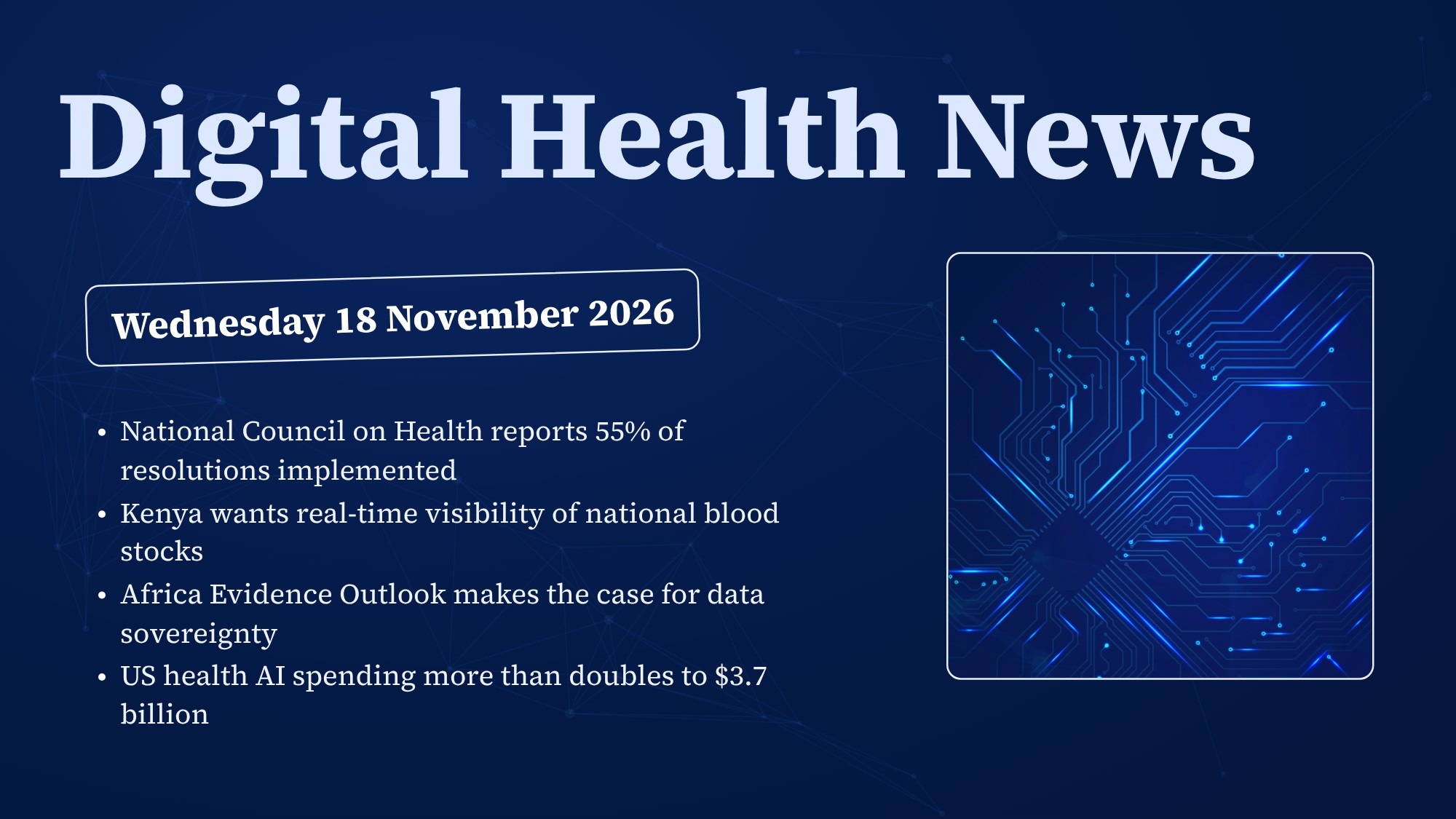
This edition opens with Nigeria’s National Council on Health, where the federal ministry reported that just over half of last year’s resolutions have been implemented. Also: Kenya’s push for real-time blood stock data, a new report on African data sovereignty and fresh figures on health AI spending in the US.
National Council on Health reports 55% of resolutions implemented
At the opening of the 67th National Council on Health technical session in Lafia, Nasarawa State, the Federal Ministry of Health and Social Welfare reported 55 per cent implementation of the 20 resolutions from the 66th Council. All 36 states and the FCT submitted progress reports, but only 412 of 740 expected state-level reports arrived (56 per cent), and no state reported on all 20 resolutions. Director of Health Planning, Research and Statistics Dr John Ovuoraye recommended quarterly reporting through the Multi-Source Data Analytics and Triangulation (MSDAT) dashboard. The full council, chaired by Coordinating Minister Prof. Muhammad Ali Pate, meets on 19 and 20 November, with digital health and data-driven decision-making on the agenda.
Source: Nairametrics, 17 November 2026; THISDAY, 17 November 2026
Kenya wants real-time visibility of national blood stocks
At the Terumo BCT Africa Hackathon 2026 in Nairobi on 13 November, Dr Jeremiah Mumo of Kenya’s Digital Health Agency said he wants “a system which will be able to predict” blood status across the country. The winning team, Relay, a Kenyan and Nigerian team, took US$5,000 for HemoGrid, which helps hospitals and blood banks find eligible stock and coordinate transfers, with staff approving each one. The organisers are clear that these are prototypes built without real patient or donor records, and that facility testing and regulatory review must come before any rollout.
Source: Capital FM, 14 November 2026; CIO Africa, 13 November 2026
Africa Evidence Outlook makes the case for data sovereignty
The Africa Evidence Outlook, from the African Population and Health Research Centre (APHRC), the Science for Africa Foundation and GSMA, was launched at a research symposium in Nairobi. It reviewed more than 20 data and knowledge systems, drawing on evidence from 67 institutions in 28 countries, and found that Africa produces about 2.8 per cent of global scientific knowledge but holds less than 1 per cent of the world’s computing capacity. It proposes eight interventions to strengthen African ownership of data and research. Science for Africa Foundation CEO Dr Tom Kariuki said data sovereignty is about “setting the terms of access, use, and sharing”, not restricting data movement.
Source: Citizen Digital, 11 November 2026
US health AI spending more than doubles to $3.7 billion
A Menlo Partners report, based on a poll of more than 550 US healthcare and life sciences executives, puts health AI investment at $3.7 billion, more than double the previous year. Spending on clinical copilots grew about fivefold to $550 million, and on patient engagement and front-office AI about fivefold to $450 million. Legacy vendors took 68 per cent of new ambient scribing spend in 2026. The signal for African buyers is that value is moving to AI that sits inside existing records and workflows.
Source: Healthcare Dive, 16 November 2026
My take
The National Council on Health figures are a useful mirror. A 55 per cent implementation rate matters less than the fact that only 56 per cent of expected state reports arrived: you cannot manage what is not reported. A shared dashboard such as MSDAT is sensible, but it works only when states have the staff, connectivity and incentives to report on time, a point that echoes Monday’s look at the 12 priority actions from the Joint Annual Review. Kenya’s blood hackathon shows the same pattern at facility level: real-time visibility depends on common standards and agreed data sharing, not clever prototypes alone. The Africa Evidence Outlook asks who sets those terms, and under the NDPA 2023 Nigeria already has a legal basis to set them. The US numbers suggest AI spending follows integration. Interoperability first, then AI.
Join the conversation in the Digital Health Focus group on LinkedIn: Digital Health Focus.
Get every edition on WhatsApp: follow the Digital Health Focus channel.
These are my own views, not those of any employer, past or present.