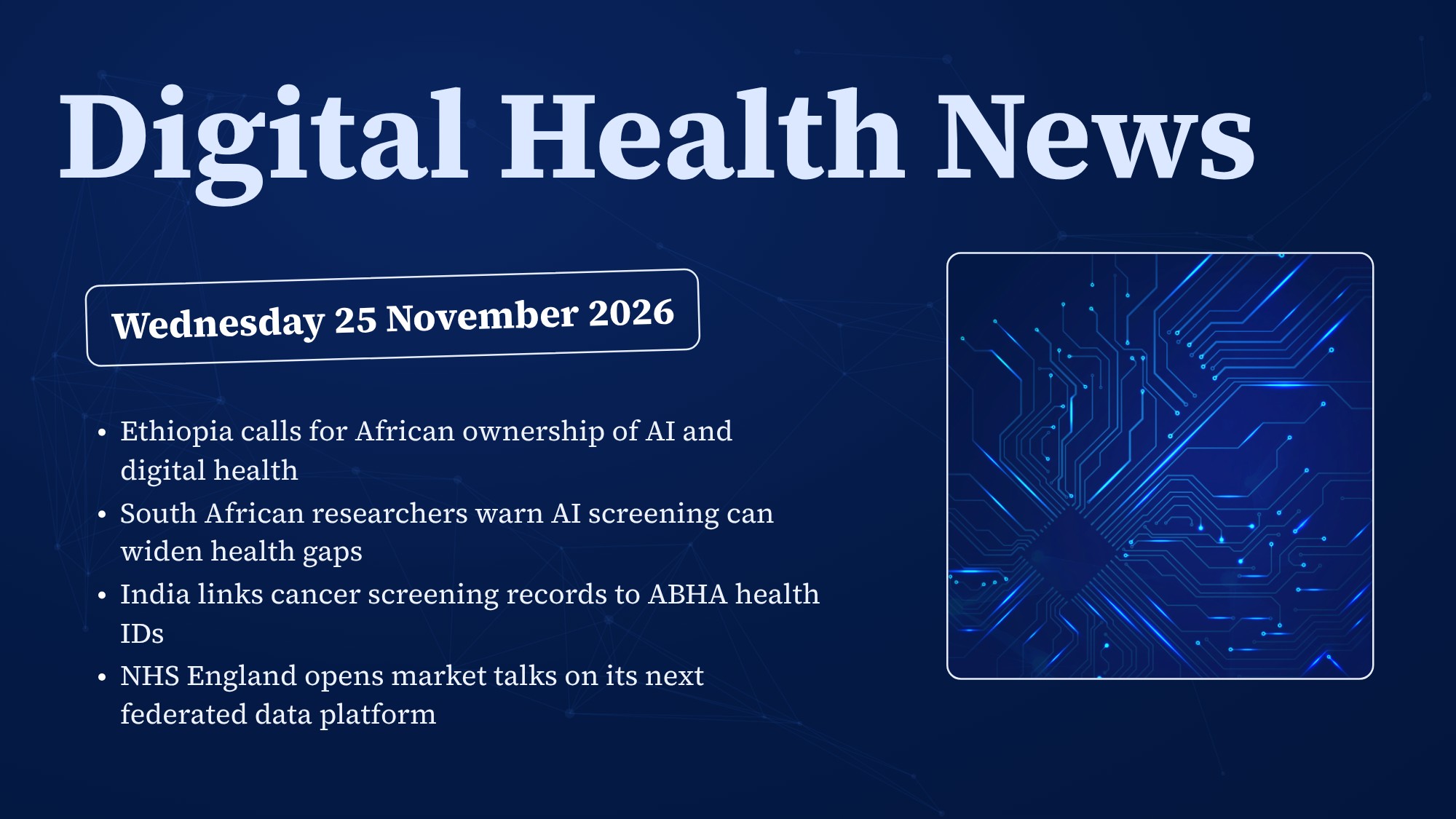
Digital health sovereignty was the theme in Addis Ababa this week, as African leaders opened CPHIA 2026 with a call to own the AI and data systems their health services depend on. This edition also covers AI screening in South Africa, India’s push to link cancer records to health IDs and the NHS’s next data platform.
Ethiopia calls for African ownership of AI and digital health
Ethiopia’s Prime Minister Abiy Ahmed, speaking as African Union Champion for AI and Digital Health, opened the 5th International Conference on Public Health in Africa (CPHIA 2026), which runs from 23 to 27 November in Addis Ababa. He said digital tools should be tested under local conditions and work in African languages, and that countries should protect health data under rules they set themselves while building secure ways to share knowledge across borders. “Distance should no longer mean working alone,” he said, describing midwives consulting specialists remotely and records that follow patients between facilities. Africa CDC reports that Ethiopia also showcased its investments in electronic health records, community-level digital systems and AI capabilities.
Source: Fana Media Corporation, 23 November 2026; Africa CDC, 24 November 2026
South African researchers warn AI screening can widen health gaps
South African mobile clinics use AI to read chest X-rays for signs of tuberculosis, and Stop TB Partnership figures from December 2024 show one AI-assisted programme reached more than 450,000 people through 33 mobile clinics. Writing in The Conversation, Professor Rennie Naidoo of the University of the Witwatersrand argues that such tools can reinforce inequality when their data under-represent rural or poorly resourced communities. The piece recommends representative local data, regular bias audits, transparent decision-making and community participation in design and evaluation, issues that apply to any health system adopting AI screening at scale.
Source: iAfrica (The Conversation), 24 November 2026
India links cancer screening records to ABHA health IDs
India’s Union health ministry said cancer patients’ screening records should be linked to their Ayushman Bharat Health Account (ABHA) IDs so that care can continue across facilities. Speaking at the National Cancer Grid annual meeting on 21 November, Health Secretary Punya Salila Srivastava said around 99 crore (990 million) ABHA IDs have been created and about 100 crore health records linked. She also launched NCG VISHWAS, an AI-enabled patient education initiative on breast, cervical and oral cancers in Hindi, Marathi, Tamil and English. For African countries building national health IDs, it shows how a single identifier can connect screening programmes to later treatment.
Source: ThePrint (PTI), 21 November 2026
NHS England opens market talks on its next federated data platform
The NHS Transformation Directorate is inviting suppliers with innovative solutions and ideas to help inform the development of the future federated data platform (FDP), with formal procurement due to begin in the second half of 2027. Suppliers can join a live broadcast on 1 December 2026. The same report notes that the NHS England board raised its risk score for technology and innovation from 8 to 12. Early market engagement of this kind lets a health system test options before committing to a long-term national data contract.
Source: HTN, 24 November 2026
Each of these stories asks who controls health data and how it is used. Ethiopia framed digital health sovereignty as setting national rules for data while sharing knowledge across borders. South African researchers point to the risk of AI tools trained on data that leave communities out. India is using one health ID to connect screening and treatment records, and England is gathering ideas for the next version of its national data platform. An earlier edition looked at the case for African data sovereignty. Which of these approaches would work in your health system?
Join the conversation in the Digital Health Focus group on LinkedIn: Digital Health Focus.
Get every edition on WhatsApp: follow the Digital Health Focus channel.
These are my own views, not those of any employer, past or present.