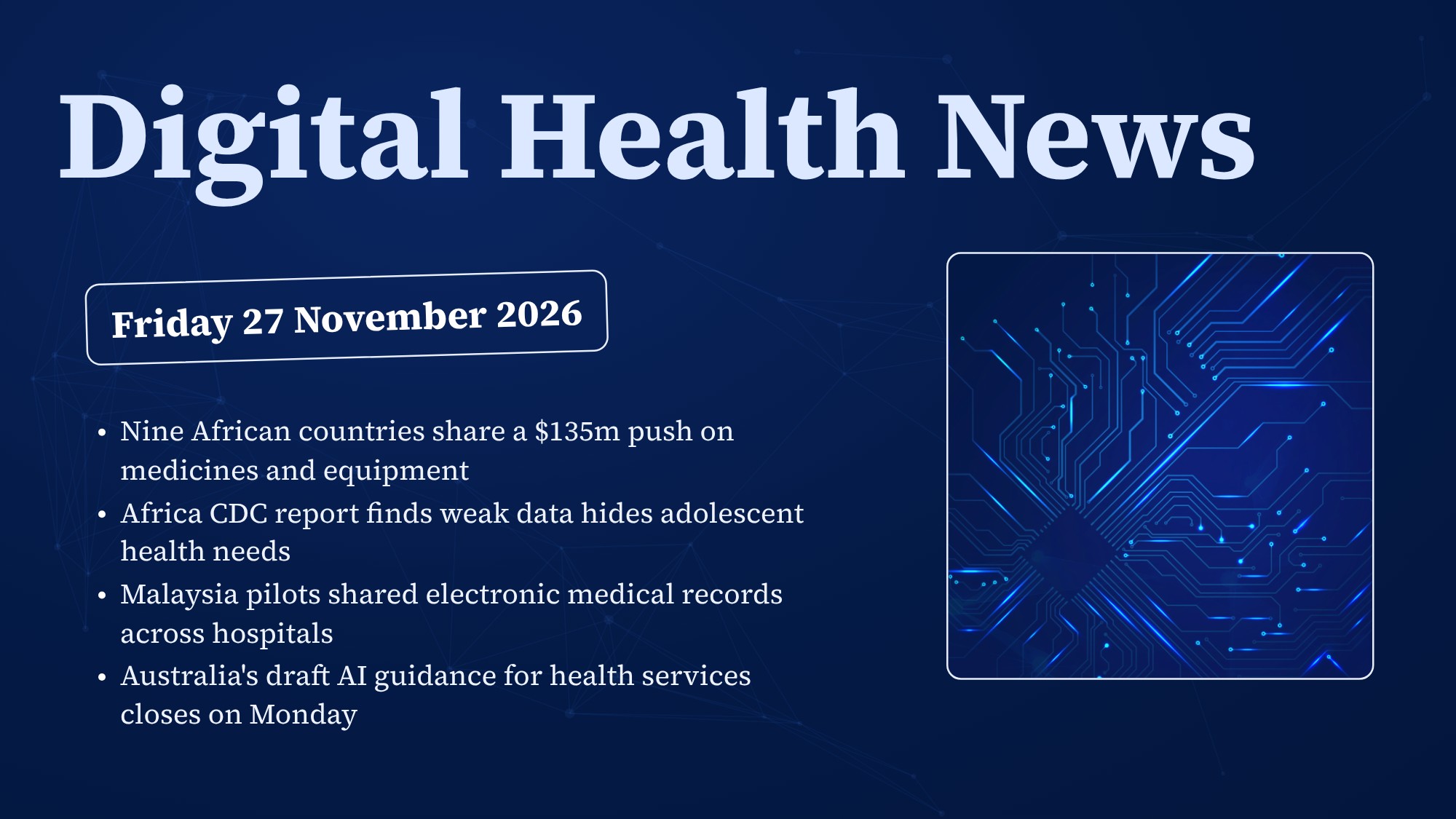
Africa health financing leads this edition, with a $135 million commitment for medicines and equipment across nine African countries announced at CPHIA 2026 in Addis Ababa. We also cover new continental data on adolescent health from Africa CDC, Malaysia’s shared medical records pilot and Australia’s draft AI guidance for health services.
Nine African countries share a $135m push on medicines and equipment
The Mohamed bin Zayed Foundation for Humanity has committed $135 million (Dh496 million) to expand access to critical medicines and medical equipment in Ethiopia, Kenya, Liberia, Malawi, Nigeria, Rwanda, Ghana, Sierra Leone and Mozambique. Announced at the International Conference on Public Health in Africa, the funding is expected to reach more than 500 health facilities and to mobilise over $550 million in matched contributions, with each government contributing at least an equivalent amount. Rwanda’s $15 million share will equip 170 health facilities, and Ethiopia’s package includes AI-enabled ultrasounds. The National reports that only 35 per cent of essential medicines are available in public health facilities in Africa.
Source: The National, 26 November 2026; The New Times (Rwanda), 26 November 2026
Africa CDC report finds weak data hides adolescent health needs
Africa CDC’s report Seen, Served and Counted draws on questionnaires from the health ministries of all 55 African Union Member States, covering 2021 to 2025. It found that only 12.9 per cent of health facilities offered adolescent- and youth-friendly services in 2025, that 37 per cent of countries do not break their data down by age and that 63 per cent cite weak data systems as a barrier. Recorded pregnancies among girls aged 10 to 14 make up 1.8 per cent of adolescent pregnancies, against a WHO estimate of 5.2 per cent. “What we cannot measure, we cannot manage, and what we cannot show, we cannot finance,” said Africa CDC Director General Jean Kaseya.
Source: Africa CDC, 22 November 2026
Malaysia pilots shared electronic medical records across hospitals
Malaysia is piloting electronic medical records across public hospitals and selected private hospital groups to improve information sharing, reduce duplicate tests and contain rising costs, according to Bank Negara Malaysia Governor Abdul Rasheed Ghaffour. He described the pilot as progress on connecting medical records nationally, an issue discussed for almost three decades. Medical insurance and takaful payouts have risen more than thirteenfold since 2003, and a base insurance plan, MediAsas, is due to launch in January 2027. For African countries expanding health insurance, it is an example of shared records being treated as part of insurance reform rather than as a separate IT project.
Source: Digital Health News, 24 November 2026
Australia’s draft AI guidance for health services closes on Monday
The Australian Commission on Safety and Quality in Health Care is consulting on draft national guidance for the adoption, use and governance of AI in health services, with recommendations on organisational accountability, procurement and ongoing monitoring of AI systems. The guidance supports the third edition of the National Safety and Quality Health Service Standards. The survey closes at 11:59pm on Monday 30 November 2026, and final guidance is planned for 2027. Health services in Africa face similar questions about who approves AI tools and how they are monitored after purchase.
Source: Pulse+IT, 25 November 2026; Australian Commission on Safety and Quality in Health Care, November 2026
The common thread this week is that money, data and governance are arriving together. Africa health financing is being tied to matched government contributions, Africa CDC is asking countries to count the adolescents their systems currently miss, Malaysia is linking shared records to insurance reform and Australia is setting out who is accountable for AI in hospitals. Wednesday’s edition on digital health sovereignty looked at who controls the data behind these systems. Which of these steps would make the biggest difference in your health system?
Join the conversation in the Digital Health Focus group on LinkedIn: Digital Health Focus.
Get every edition on WhatsApp: follow the Digital Health Focus channel.
These are my own views, not those of any employer, past or present.