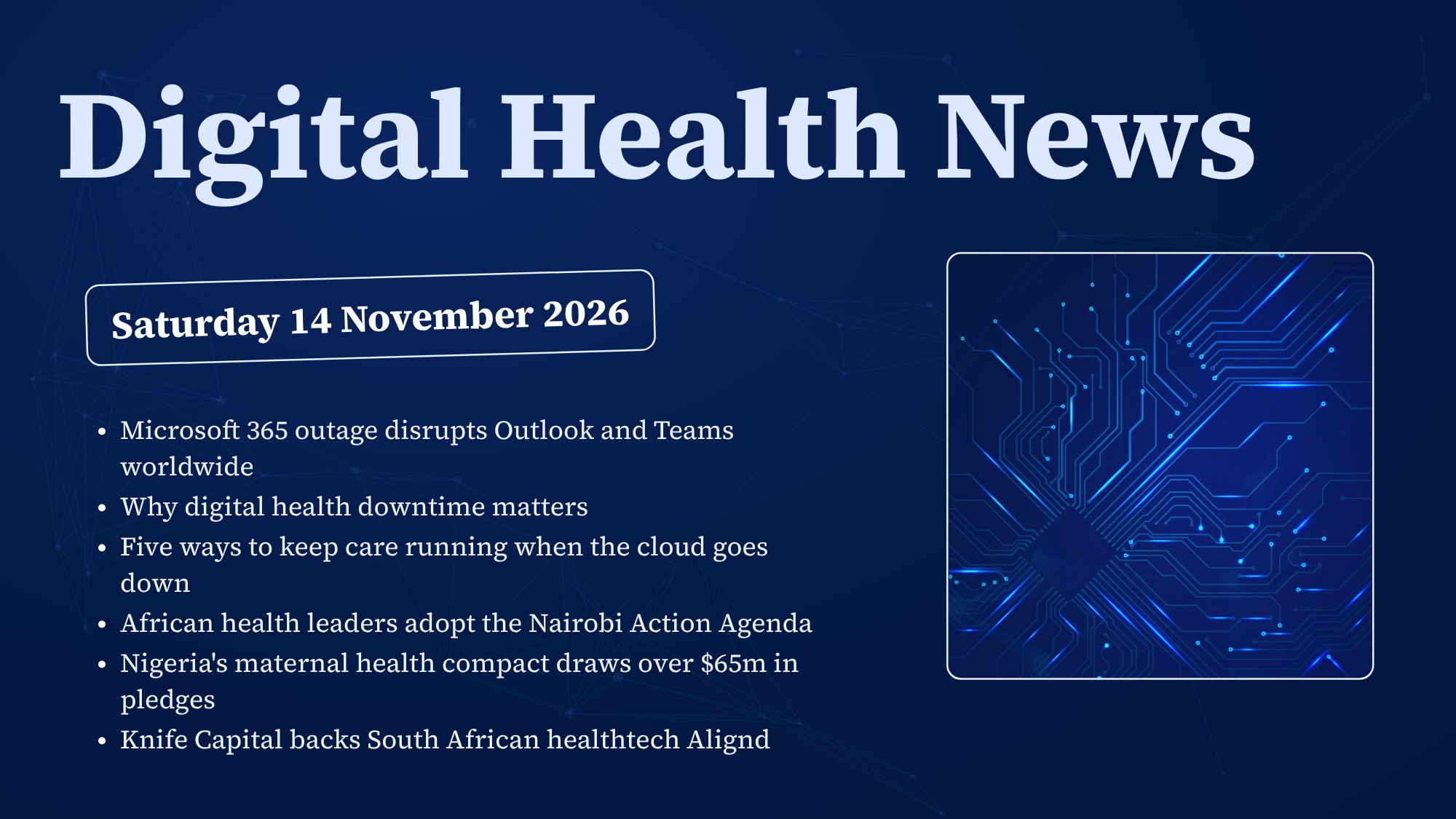
This special edition looks at digital health downtime through the lens of this week’s Microsoft outage: what happened, where things stand, why it matters for hospitals and health programmes, and how to prepare. It closes with three encouraging stories that show how quickly Africa’s digital health ecosystem is maturing.
Microsoft 365 outage disrupts Outlook and Teams worldwide
From the afternoon of Thursday 12 November (GMT), users around the world lost access to Outlook, Teams and other Microsoft 365 services. Microsoft’s service health notices listed Exchange Online, Teams, SharePoint Online, Microsoft 365 Copilot and Defender XDR, and Outlook problem reports on Downdetector peaked at more than 131,000. Al Jazeera reported disruption in 74 countries, and ABC News reported that businesses, governments, schools and healthcare providers all experienced communication disruptions.
Source: TechRadar, 13 November 2026; Al Jazeera, 13 November 2026; ABC News, 13 November 2026
Where things stand
Microsoft said the incident was “a technical issue not related to cyber or AI / agents”, introduced by an issue during an earlier network capacity upgrade. By Friday 13th November, it reported broad recovery, with email queues approaching normal levels, while warning that some users might still see intermittent issues or delayed email. Microsoft has apologised and says it will publish a full post-incident report once its review is complete.
Source: ABC News, 13 November 2026; TechRadar, 13 November 2026
Why digital health downtime matters
In most sectors an outage is an inconvenience. In health, email, chat and shared documents now carry referrals, laboratory results, rosters, supply orders and emergency coordination, so a few hours offline can slow care. The lesson is not to avoid the cloud, which gives smaller health systems access to world-class infrastructure. It is to plan for the day it is unavailable.
Five ways to keep care running when the cloud goes down
- Write and rehearse downtime procedures. Every facility should know how to register patients, order tests and hand over care on paper or offline, and should practise it.
- Keep a second communication channel. Agree in advance on an alternative (SMS, phone trees, a separate messaging platform) for urgent clinical and operational messages.
- Design for offline first. Prioritise systems that keep working locally and synchronise when connectivity returns, especially in primary care.
- Fund the running costs. Hosting, licences and support need protected recurrent budgets, with service-level agreements that spell out recovery times.
- Test backups and recovery. Back up critical data, check that it can be restored, and review incident reports from suppliers so lessons are acted on.
African health leaders adopt the Nairobi Action Agenda
The first Africa Health Data Forum closed in Nairobi on 12 November with the adoption of the Nairobi Health Data Action Agenda, which sets out eight priorities to move countries from collecting health information to using it for policy and investment. They include sustainable domestic financing, connecting fragmented data systems, investing in skilled professionals and the responsible use of digital health and AI, tracked through a continental accountability framework to 2030. The forum brought together more than 300 participants from 51 countries.
Source: WHO Regional Office for Africa, 12 November 2026; MyJoyOnline, 12 November 2026
Nigeria’s maternal health compact draws over $65m in pledges
At Nigeria’s 2026 Joint Annual Review in Abuja, seven private sector and philanthropic organisations, including DP World, Bayer, UNICEF and Roche, submitted letters of intent for more than $65 million in proposed commitments under the MAMII Private Sector Compact, focused on 172 local government areas with a high burden of maternal deaths. The MTN Foundation is offering connectivity, AI and digital tools, and a government digital platform will show where each partner is working and where gaps remain.
Source: Premium Times via allAfrica, 11 November 2026
Knife Capital backs South African healthtech Alignd
Cape Town-based Alignd, which builds outcome-linked payment arrangements with medical schemes, has received investment from Knife Capital’s Knife Fund III. The company says its palliative care programme produced savings of about R600 million (around $36 million) and that it works with more than 500 providers and over 3.3 million beneficiaries across seven schemes. The funds will expand its maternity and kidney care programmes.
Source: TechMoran, 13 November 2026
My take
The Microsoft outage is a reminder that every health system, in Lagos or London, depends on infrastructure it does not fully control. Digital health downtime is not a reason to slow down; it is a design requirement. The organisations that cope best are those that planned for failure: offline workflows, a second channel for urgent messages, funded support contracts and drills. Africa is well placed here. Many of our teams already work with intermittent connectivity, and that experience is a real asset. The Nairobi Action Agenda, Nigeria’s maternal health compact and investor backing for Alignd show governments, partners and capital lining up behind data-driven care. For partners looking at the continent, the opportunity is to build resilient, interoperable systems from the start, with data protection under laws such as Nigeria’s NDPA 2023. As Ghana’s DHIMS2 interruption and recovery showed, continuity is a shared responsibility.
Join the conversation in the Digital Health Focus group on LinkedIn: Digital Health Focus.
Get every edition on WhatsApp: follow the Digital Health Focus channel.
These are my own views, not those of any employer, past or present.