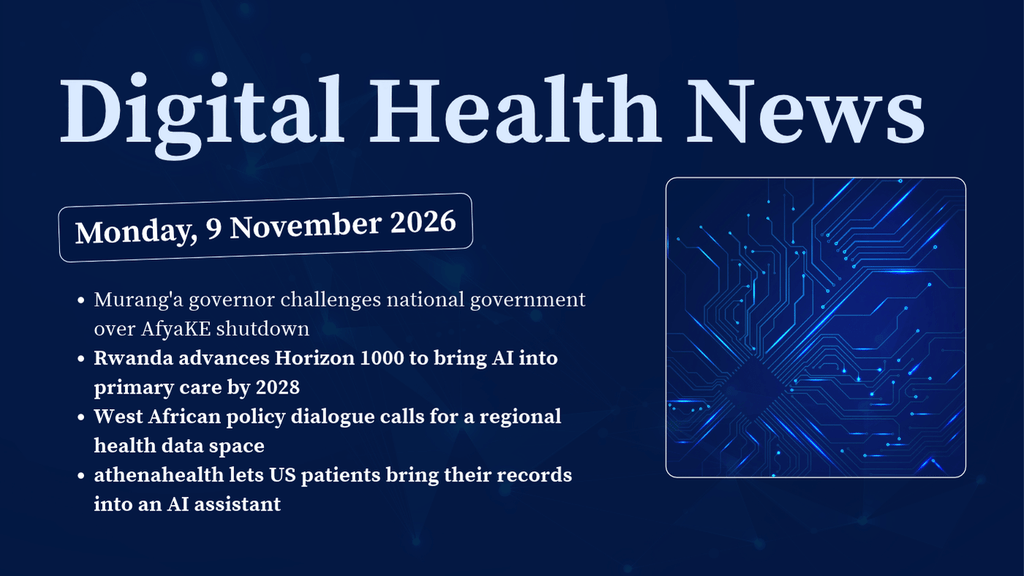
This edition covers a dispute in Kenya over a county digital health platform, Rwanda’s next steps on AI in primary care, new proceedings on health data in West Africa, and a US move that lets patients take their records into an AI assistant.
Murang’a governor challenges national government over AfyaKE shutdown
Murang’a Governor Irungu Kang’ata says the national government disrupted services by ordering the deactivation of the county’s AfyaKE digital health platform, which he says supported telemedicine for nearly 30,000 elderly patients. The High Court issued interim orders on 23 October to restore access, and the matter returns to court on 18 November. The Ministry of Health denies shutting the platform, saying it does not own or control it and that no certification application was submitted. As Kenya moves facilities onto certified systems, the case shows how national standards and county-built tools can collide when certification paths are unclear.
Source: The Standard (Kenya), 5 November 2026
Rwanda advances Horizon 1000 to bring AI into primary care by 2028
Rwanda is advancing the Horizon 1000 initiative to explore how AI can improve care at primary health facilities and in communities by 2028, by integrating AI-powered support into its eBuzima digital health platform. Health Minister Dr Sabin Nsanzimana said rigorous testing for safety and effectiveness will come before any AI tool is used to inform patient care, and that he recently met partners from the Gates Foundation and OpenAI. Building AI into an existing national platform, rather than a standalone app, is the detail other ministries should watch.
Source: TechReviewAfrica, 4 November 2026
West African policy dialogue calls for a regional health data space
Newly reported proceedings from a West African policy dialogue in Ghana, involving participants from seven countries including Ghana, Liberia, Sierra Leone and Côte d’Ivoire, point to continued reliance on paper-based data collection at peripheral facilities, staff attrition and fragmented institutions. Participants called for digital data collection, interoperable systems, common data platforms and a West African Health Data Space. The proceedings note that only 35 per cent of countries had submitted complete reports on time.
Source: Bioengineer.org (via Scienmag, summarising BMC Proceedings), 8 November 2026
athenahealth lets US patients bring their records into an AI assistant
US health IT company athenahealth has launched a tool that lets patients authorise Anthropic’s Claude to pull data such as lab results, medications and allergies from their athenahealth records, using the Model Context Protocol. The company argues that because the exchange is patient-directed, HIPAA does not apply, while lawyers quoted in the report raise questions about liability and data protection. For African regulators, it is an early test of how consent and patient access rights apply when health data leaves the provider’s system at the patient’s request.
Source: GovInfoSecurity (ISMG), 3 November 2026
My take
Governance is now the main event in digital health. Kenya’s AfyaKE dispute is what happens when a national certification push meets county systems that grew up on their own: patients risk being caught in the middle. Clear standards, published certification routes and realistic transition support matter as much as the deadline itself. Rwanda’s choice to build AI into eBuzima, with testing first, is the right order of operations. West Africa’s call for interoperable platforms is familiar, and the gap is still paper at the facility edge and staff to run systems. The athenahealth case is a preview of a question Nigeria will face under the NDPA 2023: when a patient exports their own record to a third-party tool, who is accountable for that data? Better to settle that before the tools arrive.
Join the conversation in the Digital Health Focus group on LinkedIn: Digital Health Focus.
Get every edition on WhatsApp: follow the Digital Health Focus channel.
These are my own views, not those of any employer, past or present.