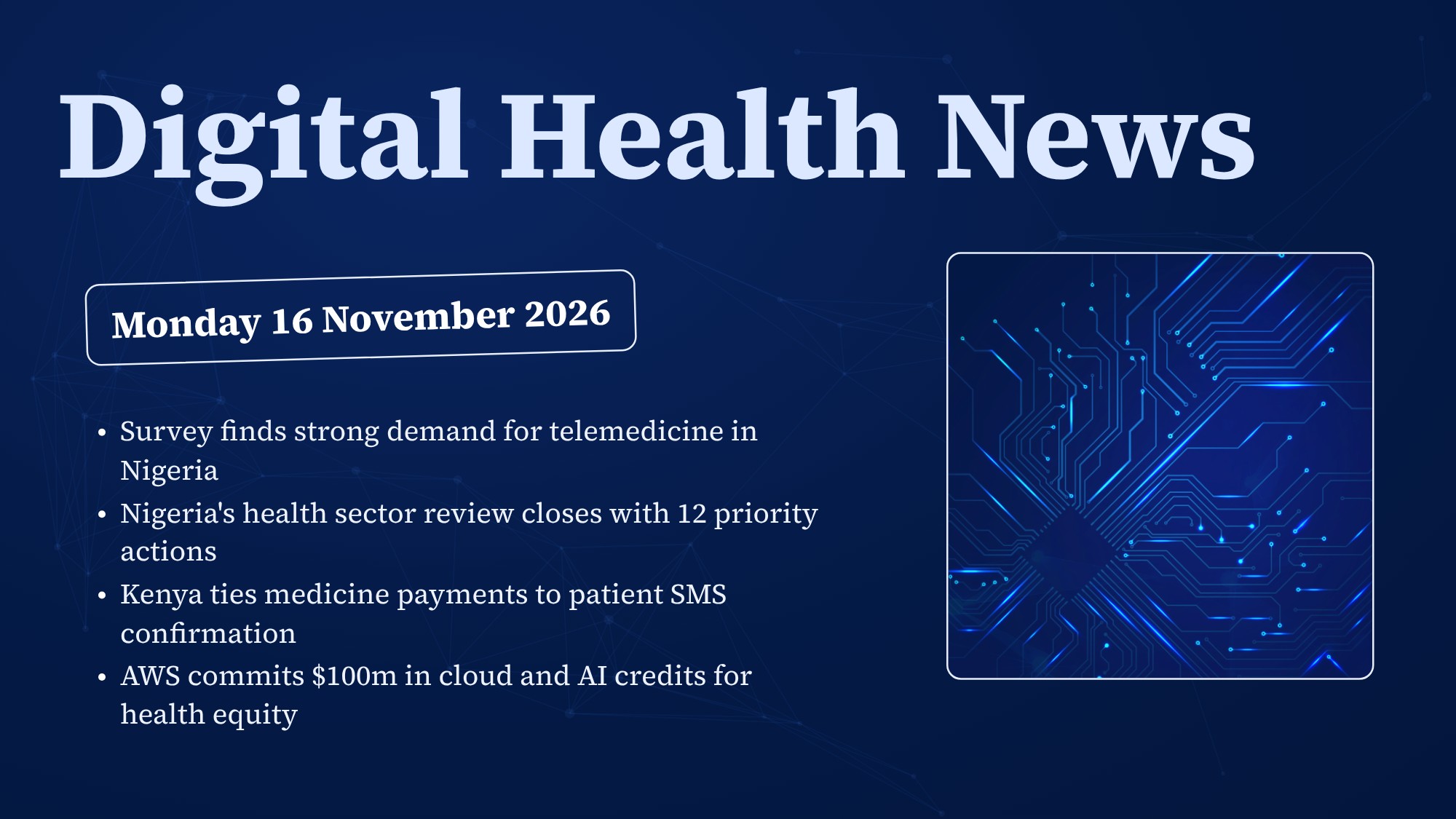
This edition looks at demand for telemedicine in Nigeria, after a new national survey found three in four adults willing to use it. Also: the 12 priority actions from Nigeria’s health sector review, Kenya’s SMS check on medicines before hospitals are paid, and a new $100 million AWS programme for underserved health.
Survey finds strong demand for telemedicine in Nigeria
The National Information Technology Development Agency (NITDA) unveiled its 2026 Nigeria Tech Outlook Report at the Digital Nigeria International Conference and Exhibition in Abuja on 11 November. Based on 2,147 household interviews and 539 health facility interviews, it found that 75.9 per cent of adults were willing to use telemedicine if available, although only 11.3 per cent had health insurance coverage. The gap between willingness and cover is the real question for anyone building virtual care: who pays, and how does it connect to facilities?
Source: Nairametrics, 11 November 2026
Nigeria’s health sector review closes with 12 priority actions
The 2026 Joint Annual Review closed in Abuja on 12 November under the theme “Together to Higher Ground: Make Reforms Data Count”. The communiqué set 12 priority actions, including strengthening DHIS2 as the national health data reporting platform, speeding up certification of primary healthcare facilities, operationalising the National Human Resources for Health Programme and increasing domestic health financing. The review noted that 2027 is the final year of the Health Sector Strategic Blueprint 2023–2027, so these actions will shape what comes next.
Source: Federal Ministry of Health and Social Welfare, 13 November 2026
Kenya ties medicine payments to patient SMS confirmation
Since 1 November, patients at Kenyan public health facilities receive text messages asking them to confirm whether they got their prescribed medicines, and the Social Health Authority withholds payment for drugs a hospital claims but did not dispense. Health Cabinet Secretary Aden Duale explained the system at the Africa Health Data Forum in Nairobi, telling patients: “If you are not given medicine, check your phone.” It is a simple example of routine digital data being used to verify claims, with patients becoming part of the audit.
Source: The Star (Kenya), 10 November 2026
AWS commits $100m in cloud and AI credits for health equity
Amazon Web Services has launched the AWS Health Impact Initiative, a five-year, $100 million commitment of AI, agentic services and cloud infrastructure for organisations closing health gaps for underserved populations worldwide. Health non-profits, government agencies, research institutions and companies can apply, and low- and middle-income countries are among the stated priorities. Awards are made as credits valid for 12 months, extendable to 24, so African teams that apply will need a plan for running costs once the credits end.
Source: Amazon, 9 November 2026
Nigerians are telling us they want telemedicine in Nigeria. Three in four adults say they would use it, yet barely one in nine has insurance to pay for care. Demand is not the bottleneck; financing and integration are. A virtual consultation needs a payer, a referral pathway and a record the next clinician can read, with consent and data handling that meet the NDPA 2023. The review’s commitment to DHIS2 is welcome, but aggregate reporting is not the same as patient-level records that move between facilities, a gap the WHO assessment of Africa’s health information systems made plain. Kenya shows what becomes possible once claims run on digital rails: patients can verify services in real time. And cloud credits help most when teams have already budgeted for the costs that remain after they expire.
Join the conversation in the Digital Health Focus group on LinkedIn: Digital Health Focus.
Get every edition on WhatsApp: follow the Digital Health Focus channel.
These are my own views, not those of any employer, past or present.